

Throughout history, humans have created their ways to project their voices over long distances. From ancient animal made horns to modern digital amplification systems, the evolution of megaphones showcases the technological advancement that proceeds to shape communication. This blog explores the journey of megaphones, from their basic beginnings to their modern, high-end technology.
1. Early Beginnings: The Birth of Voice Amplification
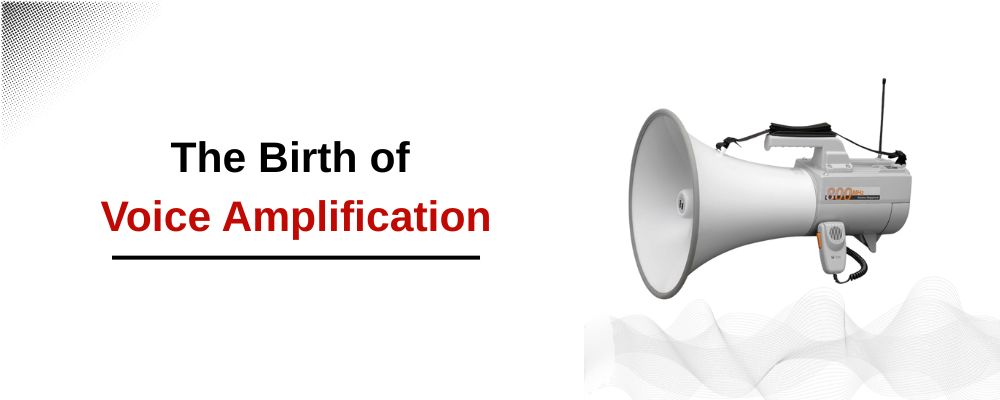
The aspiration to amplify the human voice started since ancient civilizations. Early voice projection methods were rudimentary yet effective for their time. Greek and Roman amphitheaters were designed for sound to travel naturally, allowing speakers to address large audiences without electronic assistance. The architecture of these theaters, including their curved and elevated structures, was particularly designed to study and amplify sound waves.
One of the earliest mechanical voice amplification devices was the trumpet, which belonged to the 17th century. These trumpets, made of brass or other metals, directed and slightly amplified voices through conical shapes. Sailors used speaking trumpets to communicate across long distances on ships, and town criers employed them to make announcements to the public.
2. 19th Century Innovations: The Acoustic Megaphone
The term “megaphone” originated in the 19th century and was associated with the creations of Sir Samuel Morland, who demonstrated a prototype of a megaphone-like device in 1671. However, it was Thomas Edison in the late 1800s who further refined and popularized the concept. Edison developed a large, horn-shaped device created to amplify voices for individuals with hearing impairments and for public announcements.
During this era, acoustic bullhorns relied on simple physics. Sound waves would enter the narrow end of the horn and transmit through the wider opening, increasing the sound’s intensity through mechanical means. These devices required no electricity and were used for crowd control, public events, and emergency situations. The megaphone became a standard tool in military and maritime settings, where clear,and long-distance communication was crucial. As time passed, they were adopted in theaters, political rallies, and sports events to reach large audiences effectively.
3. Electrification

The 20th century marked a significant leap forward in voice amplification with the advent of electrical technologies. The invention of the carbon microphone in the early 1900s by Thomas Edison and Emile Berliner allowed sound to be captured and amplified electronically. By the 1920s, electric-powered bullhorns began to replace their acoustic counterparts. These devices used microphones to capture sound, amplifiers to strengthen the signal, and loudspeakers to generate the voice over greater distances. This transformation allowed clarity and louder communication in noisy environments.
One of the most important uses of electric bullhorns was done during World War II, where they played a crucial role in military communications, crowd management, and public safety. Portable electric megaphones became commonplace in police work, sports events, and protests throughout the mid-20th century.
4. Technological Advancements: From Analog to Digital
The late 20th and early 21st centuries saw fantastic advancements in megaphone technology. Traditional analog bullhorns, while effective, had limitations in clarity and power output. The transition to digital amplification discovered improved sound quality, feedback suppression, and greater range.
Digital megaphones used advanced microphones, digital signal processors (DSPs), and rechargeable batteries, making them more portable. Modern bullhorns can project voices up to a mile away, delivering crystal-clear audio quality. Some also feature other aspects such as:
- Multi-mode operation: Allows for voice projection, alarm signals, and recorded messages.
- Bluetooth connectivity: Users can connect smartphones or other devices for wireless audio streaming.
- Voice modulation: Provides different sound effects or alters the speaker’s voice.
Modern materials like lightweight plastics and composites have made bullhorns easier to carry without sacrificing durability or performance.
5. Specialized Megaphones: Tailored for Different Needs

The evolution of bullhorns has resulted in the development of innovative devices suited for various applications. Today, there are several types of megaphones, each designed to meet specific needs:
- Handheld Megaphones: Compact and portable, these are commonly used by sports coaches, law enforcement, and event organizers. Pyle and MyMealivos megaphones can be a great option to go for handheld megaphones.
- Mounted PA Systems: Bigger and more powerful, these systems are often used in stadiums, public transportation, and large gatherings.
- Marine and Military Megaphones: Designed to withstand harsh environments, these are waterproof, durable, and equipped with long-range capabilities.
- Emergency Megaphones: These models feature sirens and pre-recorded messages to facilitate emergency communication. For overall professional, industrial nas well as kids use 5 Core is an ideal megaphone.
6. The Future of Voice Amplification
Looking ahead, the future of bullhorns is likely to be shaped by ongoing advancements in AI and wireless technology. Innovations in voice recognition and real-time translation of future bullhorns provide multilingual capabilities, breaking language barriers in public communication.
Wearable megaphones, integrated with smart devices, could revolutionize personal amplification. The improvements in directional sound lead speakers to project their voices with pinpoint accuracy while minimizing noise pollution.
Conclusion
The evolution of megaphones highlights the broader story of technological innovation and humans’ means of communication. As technology continues to advance, bullhorn will surely become even more versatile, powerful, and integrated into our everyday lives.
Whether used for public safety, social advocacy, or entertainment, megaphones remain a testament to humanity’s enduring desire to be heard. Their evolution not only amplifies sound but also the voices and messages that shape our world.